
Who Spends More on Relationships in Nigeria—Men or Women?
Ask a group of Nigerians who spends more in relationships and the discussion may become louder than the restaurant bill.
Some men will point to dates, transportation, birthday gifts, surprise deliveries and Valentine’s Day expenses. Some women will respond with the planning, reminders, emotional support and behind-the-scenes work required to keep the relationship running.
Both groups may have a point.
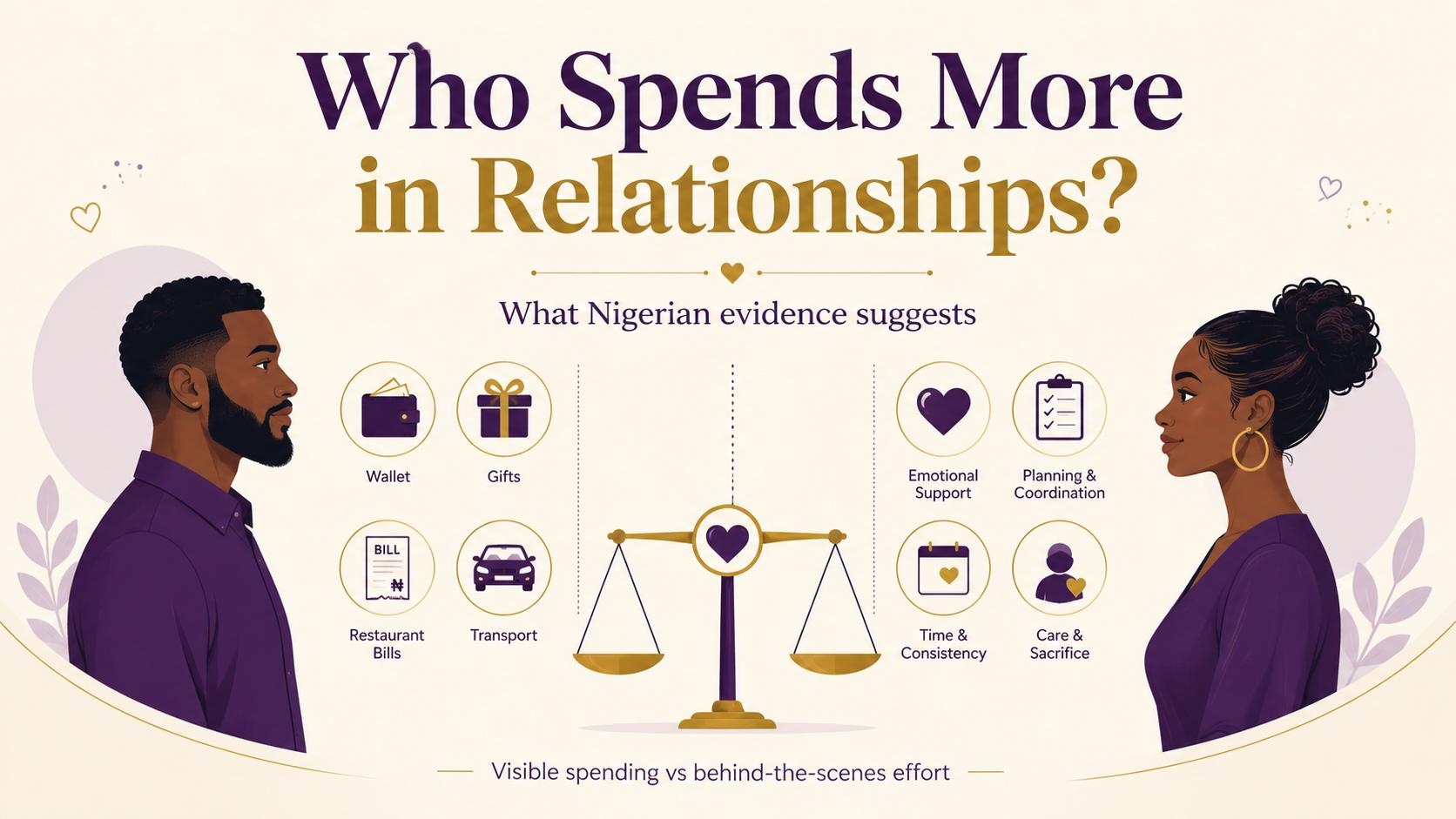
The fairest answer is that limited available evidence suggests that men may spend more in visible cash categories, particularly around major romantic occasions, while women may contribute more of the less visible work involved in planning and maintaining relationships.
What the available Nigerian evidence suggests
One of the few published Nigerian comparisons comes from a 2021 Picodi Valentine’s Day study. It reported that Nigerian men planned to spend an average of ₦13,088 on Valentine’s gifts, compared with ₦9,792 among women—a 34% difference.
However, this should not be treated as proof that men spend more throughout relationships. The research focused only on Valentine’s Day, combined more than 11,000 participants across 38 countries and did not publish the size or composition of its Nigerian sample. The figures are also several years old.
A newer 2025 SBM Intelligence survey showed that romantic spending remains significant in Nigeria. Conducted among adults in Lagos, Abuja and Port Harcourt, it found that one-third of respondents planned to spend between ₦51,000 and ₦100,000 on Valentine’s Day, while 11.7% planned to spend between ₦201,000 and ₦500,000. Restaurants, cinemas, hotels and local vacations featured prominently alongside gifts such as food, perfume, jewellery and watches. The published summary, however, did not provide a clear men-versus-women spending comparison.
So, men may currently lead the receipt competition, but that is only part of the relationship economy.
Where men may spend more money
Traditional expectations can place visible financial responsibilities on men, particularly in heterosexual relationships.
This may include paying for restaurant dates, covering transportation, buying major birthday gifts, arranging Valentine’s outings and financing large surprise celebrations.
Spending category | What a balanced survey should examine |
Gifts | Who buys more gifts, who spends more per gift and who gives outside major occasions |
Dates | Who pays the full bill, who contributes and who selects cheaper or more expensive activities |
Transportation | Fuel, ride-hailing, flights and the cost of travelling to see each other |
Surprise deliveries | Who pays for flowers, cakes, food, money bouquets and delivery charges |
Gifts, venue, food, cake, decorations, photography and outings | |
Valentine’s Day | Gifts, experiences, travel, accommodation and other celebration costs |
But simply asking, “Who paid?” can produce an incomplete result.
One partner may pay for dinner while the other pays for transportation, buys an outfit, selects the gift, books the restaurant and spends several hours organising the evening.
Where women’s contribution may be overlooked
Relationship spending is not limited to money.
Someone also remembers the birthday, notices that a gift must be ordered, contacts the recipient’s friends, compares vendors, confirms the address, tracks the delivery and makes sure the surprise does not collapse because one person posted it too early.
This is sometimes described as mental labour: the remembering, anticipating, planning, organising and monitoring required to keep shared responsibilities moving.
A systematic review of 31 studies found that women generally performed a larger share of mental labour, particularly around household and childcare planning. However, most studies involved middle-class participants in the United States or Europe, so their findings should not automatically be presented as Nigerian evidence. They show why this work should be measured in a Nigerian survey—not what the Nigerian result must be.
For relationships, the survey should examine who usually:
Remembers birthdays and anniversaries
Plans dates and celebrations
Selects and orders gifts
Checks on the partner’s emotional wellbeing
Resolves arguments and starts difficult conversations
Maintains relationships with friends and family
Follows up when the partner is ill, stressed or struggling
These activities may not produce receipts, but they require time and attention.
A birthday celebration shows the gap clearly
Imagine that a man pays ₦150,000 for his partner’s birthday.
That sounds like the larger contribution—and financially, it may be.
But imagine that the woman planned his birthday two months earlier. She contacted his friends, found a venue, chose the cake, arranged decorations, created a guest list, ordered a personalised gift and kept everybody informed.
She may have spent less money but contributed more planning time.
Neither contribution should be dismissed.
The problem starts when one person believes money is the only valid evidence of effort, while the other believes planning should excuse them from contributing financially.
Income matters more than raw naira
Suppose one partner earns ₦1 million monthly and spends ₦100,000 on the relationship. The other earns ₦200,000 and spends ₦40,000.
The first person spent more money, but the second spent a larger share of their income.
A fair study should therefore report both:
The amount contributed in naira
The percentage of personal disposable income contributed
It should also distinguish between voluntary gifts and expenses a partner feels pressured to cover.
A large gift bought comfortably is different from a smaller gift that pushes someone into debt.
The answer may change during the relationship
Spending patterns are unlikely to remain the same at every stage.
During early dating, one person may cover most restaurant and transportation expenses. In a longer relationship, both partners may begin contributing according to income. Marriage, children, long-distance travel and joint accounts can change the pattern again.
Age, city and income may matter as much as gender.
A Lagos couple using ride-hailing services and visiting restaurants will have different costs from a couple living in the same university community. A long-distance relationship between Nigeria and the diaspora will involve travel, international payments and delivery costs that local couples do not face.
That is why the article should not reduce every relationship to one national average.
So, who really spends more?
Based on the limited Nigerian evidence currently available, men appear more likely to spend more money on visible romantic expenses, particularly gifts and major occasions such as Valentine’s Day.
But that does not settle the wider question.
Women may contribute more planning, remembering, emotional support and relationship management. Because those contributions do not always come with bank alerts or receipts, they are easier to overlook.
The most accurate conclusion is that relationships have two economies:
the money people spend and the work people rarely count.
Men may lead in the first. Women may lead in the second.
The real relationship spending gap is not simply about deciding who does more. It is about whether both people recognise what the other person contributes—and whether the arrangement feels fair to them.
Comments
Be the first to comment.
Leave a comment