
Should You Return Gifts After a Breakup? Nigerians Have Their Say
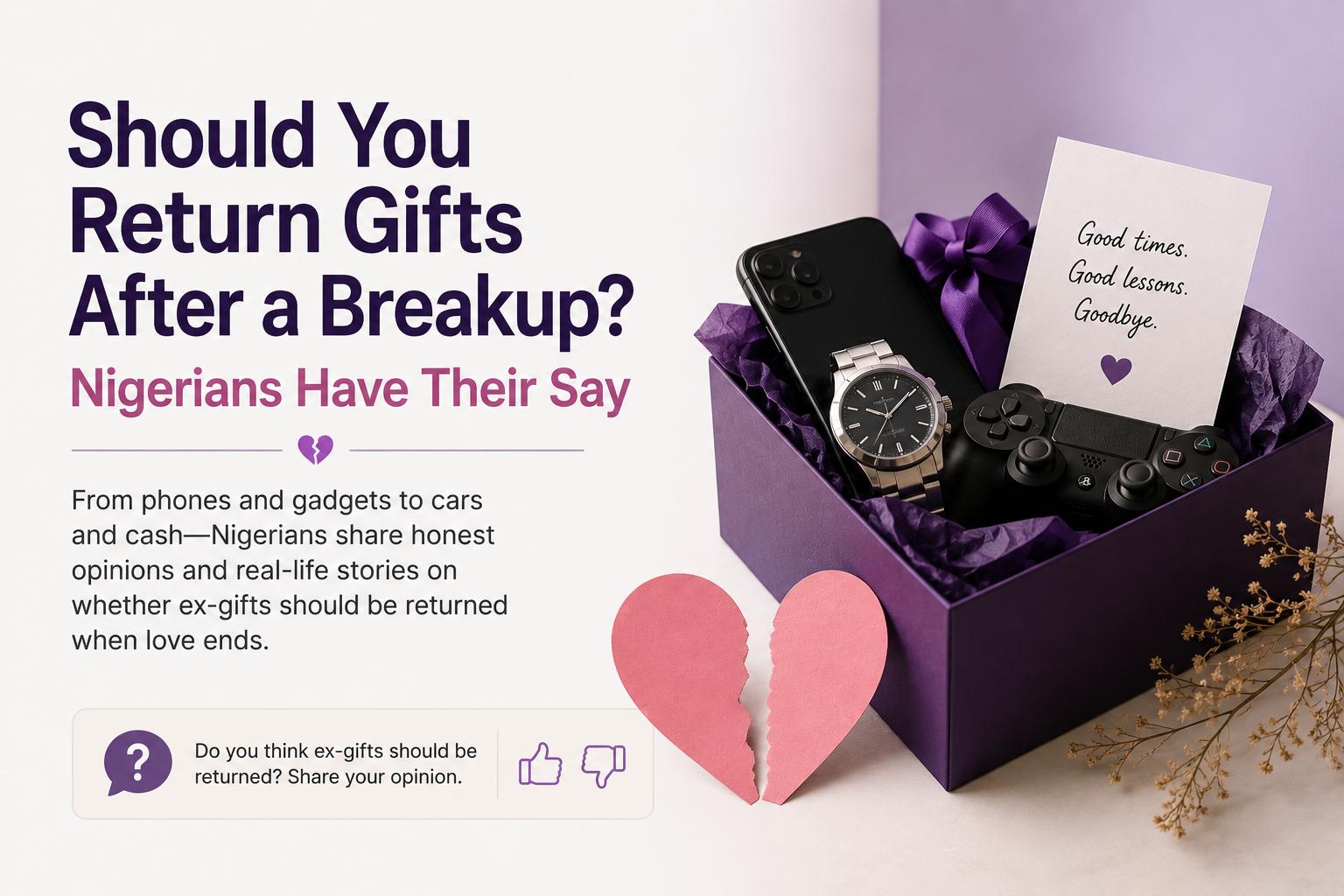
The relationship is over. The goodbye messages have been sent. Then someone remembers the phone, wristwatch, PS5, money bouquet—or car—and suddenly the breakup develops a customer-service department.
Should gifts be returned when love ends, or is a gift still a gift even after the giver becomes an ex?
Published Nigerian interviews reveal sharply divided opinions. Some people believe asking for gifts back is embarrassing and transactional. Others have reclaimed expensive gadgets, furniture, vehicles and even food after messy breakups. These stories reflect individual experiences rather than a nationally representative survey, but they show just how complicated the question can become.
The basic rule: a gift is not a relationship subscription
When someone freely gives a birthday, Valentine’s Day or anniversary present, the gift should not normally become repayable because the relationship ended.
You did not rent the perfume until further notice.
The recipient did not agree to return the phone after six months of romance.
And a transfer made during the relationship should not suddenly become a loan because one person is angry.
The price of a gift does not change its original purpose. A ₦500,000 phone may be expensive, but if it was clearly presented as a birthday gift, demanding it back after the breakup can make the original gesture appear conditional.
There are, however, important exceptions.
Item | Sensible approach |
Ordinary birthday or Valentine’s gift | The recipient can generally keep it |
Something clearly borrowed | Return it |
The ex’s personal belongings | Return them promptly |
A family heirloom | Returning it is usually the respectful choice |
Jointly purchased property | Discuss ownership and contributions |
Engagement ring | Treat separately and seek advice if valuable |
Gift given under a clear condition | Consider whether that condition failed |
The key question is not only, “Who paid for it?”
It is also, “Was this genuinely given away, or was it borrowed, shared or tied to a specific condition?”
Should expensive gifts be returned?
Expense alone should not automatically turn a gift into a refundable purchase.
However, high-value items create more room for disagreement. A car may have been described romantically as “your car” while remaining registered in the giver’s name. A laptop may have been bought for the recipient’s business but treated by the couple as a shared investment. Rent payments and business equipment can also blur the line between generosity and joint financial responsibility.
Recent Nigerian interviews demonstrate this confusion. The items people attempted to reclaim included an iPad, PS5, work chair, air fryer and vehicle. In several stories, the central dispute was not simply about gifts; it was about who genuinely owned or paid for shared property.
A sensible rule is:
Return what does not belong to you. Keep what was unambiguously given to you. Discuss everything in between.
For very valuable property, documentation matters more than breakup arguments. Receipts, registration documents, messages and evidence of payment may clarify whether an item was a gift, loan or shared purchase.
What about the engagement ring?
An engagement ring is different from an ordinary romantic gift because it represents an intention to marry.
From an etiquette perspective, returning the ring may be appropriate when:
It is a family heirloom
It was clearly given on the understanding that marriage would take place
The couple mutually agrees that it should be returned
Keeping it would create a prolonged and costly dispute
The legal position should not be guessed from foreign films or social-media arguments. LawPàdí explains that Nigerian law recognises claims for breach of promise to marry when a genuine promise and subsequent breach can be proven. Possible damages may include wedding expenses and other financial losses. However, that does not create one automatic answer for the ownership of every engagement ring.
For a particularly expensive or inherited ring, both parties should obtain Nigerian legal advice rather than turning the matter into a family WhatsApp tribunal.
Is it acceptable to keep gifts from an ex?
Yes.
Keeping a useful gift does not necessarily mean you still want the giver.
A blender remains a blender.
Headphones do not become emotionally unavailable because the relationship failed.
You can continue using clothes, electronics, books and household items when they no longer produce a strong emotional reaction. The question is whether you are keeping the item because it is useful—or because it helps you remain psychologically attached to the relationship.
Sage Journals research involving 91 young adults after recent breakups found that spontaneous memories of former relationships were associated with breakup-related distress. This does not prove that every gift from an ex delays recovery, but it suggests that emotionally loaded reminders can affect people differently.
When an item feels too painful, you do not need to decide immediately. Put it somewhere out of sight and reconsider it after the emotions have settled.
Keeping the gift is acceptable.
Letting it go is also acceptable.
Should personalised gifts be thrown away?
There is no compulsory post-breakup bonfire.
Personalised gifts can be especially difficult because they may contain names, photographs, dates, private messages or references that no longer fit your life.
You have several options:
Store the item temporarily
Remove or cover the personalisation
Repurpose it
Donate it when doing so would not expose private information
Recycle it
Dispose of it quietly
Research into the deliberate destruction of meaningful possessions found that objects can carry memories, identity and symbolic value. Some participants experienced a sense of change after destroying emotionally loaded possessions, but the study did not suggest that destruction is necessary or appropriate for everyone.
In other words, tearing up a framed photograph may feel freeing to one person and deeply regrettable to another.
Do not make the decision simply because social media says every breakup requires dramatic cleansing.
Is gifting after a breakup manipulative?
Sometimes.
A gift after a breakup may be harmless when it is:
A genuine apology with no expectation of reconciliation
The return of something belonging to the other person
A previously arranged birthday or graduation gift
A final gesture both people are comfortable receiving
It becomes manipulative when the gift is used to create obligation.
Examples include sending expensive items after the recipient has requested no contact, repeatedly asking whether the gift has changed their mind, or using money to make the other person feel guilty for leaving.
A gift should not become a Trojan horse carrying pressure, surveillance or emotional bargaining.
The simplest test is this:
Would you still send the gift if the recipient never replied and never resumed the relationship?
When the answer is no, the gift is probably not only a gift.
Do people sell gifts received from former partners?
They do.
One Nigerian interviewed by Zikoko! described reclaiming and later selling a vehicle during a marital separation, although that particular situation involved an ownership dispute rather than a straightforward gift. Other published accounts involve people recovering electronics and household items after relationships ended.
Selling an ordinary gift you genuinely own is not automatically wrong. Once the gift belongs to you, you may decide that money is more useful than keeping an emotionally uncomfortable object.
However, avoid selling:
Something merely loaned to you
A family heirloom
Shared property without agreement
An item whose ownership is disputed
Something containing another person’s private data
Before selling an expensive item immediately after a breakup, allow enough time for emotions to settle. A decision made for practical reasons is usually healthier than one made purely to punish an ex.
The Trelluna breakup-gift rulebook
The fairest approach can be reduced to six principles:
Return what was borrowed: A breakup does not transfer ownership of someone’s personal belongings.
Do not reclaim ordinary gifts out of anger: A gift should not become an invoice for time spent in the relationship.
Discuss expensive or shared property calmly: Ownership may be more complicated than either person first admits.
Treat engagement rings and heirlooms separately: They may carry family, legal and conditional significance.
Remove emotionally difficult items from sight before making permanent decisions: Keeping, donating, selling and disposing are all possible choices.
Never use a gift to force renewed contact. Generosity stops being generosity when it ignores a boundary.
So, should you return the gifts?
For most ordinary gifts, the answer is no.
A relationship ending does not erase the fact that something was freely given during happier times.
Return borrowed belongings, family heirlooms and anything that was never truly yours. Discuss engagement rings, shared assets and expensive items whose ownership is unclear. Keep useful gifts when they no longer disturb you, and sell, donate or store the items that do.
Most importantly, do not confuse recovering property with recovering the relationship.
Sometimes the healthiest conclusion is simple:
Keep the air fryer. Return the house key. Block the unnecessary drama.
Comments
Be the first to comment.
Leave a comment